




This Guide Teaches You:
- How creatine helps to provide more workout energy, improving performance and potential gains.
- What benefits you may receive from creatine monohydrate supplementation.
- How much creatine monohydrate to take per day, and when.
- About Creapure, and why it's considered the industry gold standard.
Table of Contents:
Creatine monohydrate is one of the most popular supplements used by people looking to build lean muscle mass, maximize performance, and increase strength. According to survey data, over 40% of National Collegiate Athletic Association (NCAA) athletes reported that they have used creatine.
Despite being one of the most scientifically studied sports supplement ingredients available, there’s still a huge array of misinformation that exists in gyms and on the internet. This guide will give you the creatine monohydrate facts and answer any questions you have.
If you have any questions about creatine monohydrate after reading this guide please post them in the comments below.
1. What is Creatine Monohydrate?
Creatine is similar to protein in that it is a nitrogen-containing compound, but is not a true protein. In the nutritional biochemistry world, it is known as a “non-protein” nitrogen. It can be obtained in the food we eat (typically meat and fish) or formed endogenously (in the body) from the amino acids glycine, arginine, and methionine.

2. How Does Creatine Monohydrate Work?
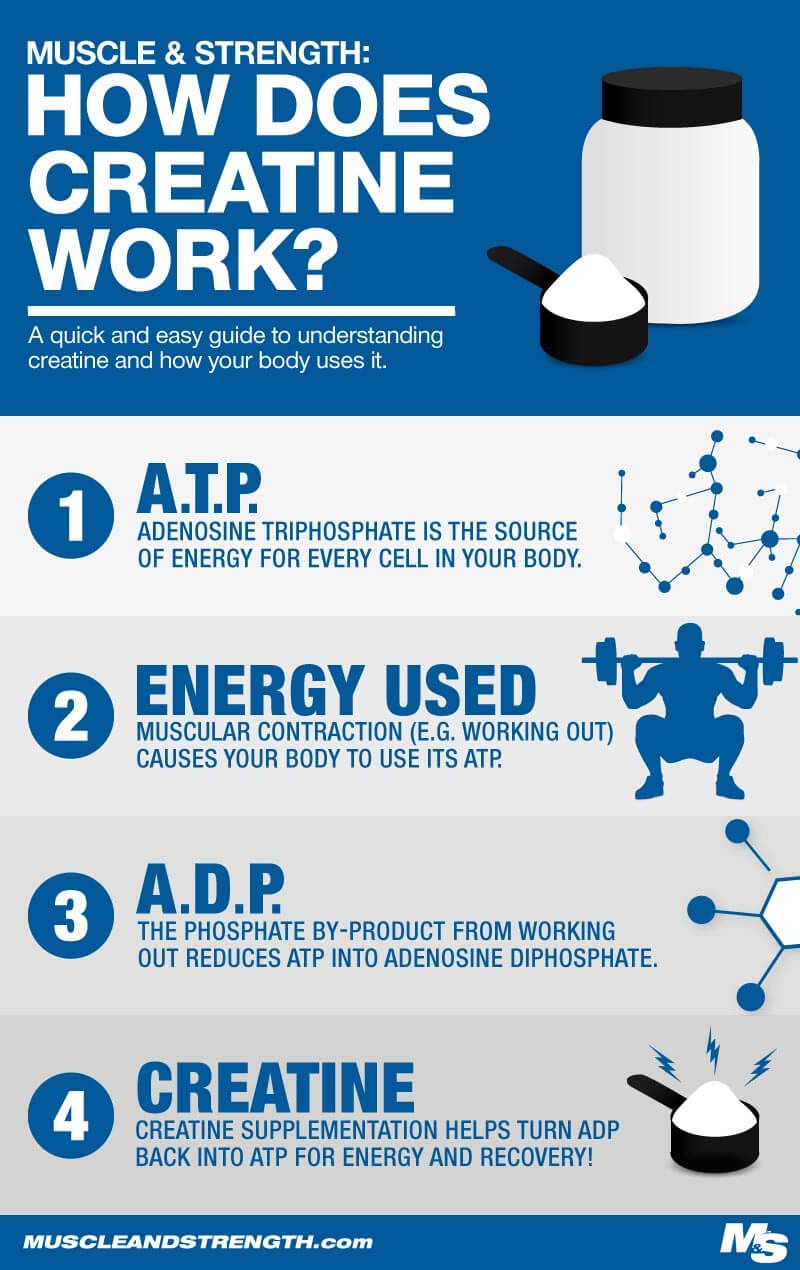
Creatine is a key player in the phosphagen energy system, the primary source of ATP (the main energy substrate in our body) during short-term, high-intensity activities. Creatine exists as both free form creatine and phosphocreatine in the body. Phosphocreatine (PC) functions as a “storehouse for high energy phosphate”.2
PC functions to replenish ATP in muscles that are rapidly contracting by transferring a phosphate group to the ADP that was formed from the hydrolysis of ATP for energy in the contracting muscle. When our muscles run out of creatine, our short-term, high-intensity energy system shuts down and our muscles are no longer able to produce force.
The use of creatine as an ergogenic aid is based upon the theory that one can increase the saturation of creatine in the muscle through supplementation. This is an important point which we will discuss in a section below.
Theoretically, increased creatine in the muscle will increase performance in short, high-intensity exercise by increasing the capacity of our phosphagen system.
3. Benefits of Creatine Monohydrate
Creatine is one of the most widely researched supplements. In fact, a google scholar search for the terms “creatine supplementation” yielded 6,740 scholarly articles and a PubMed search yielded 562 articles, indicating there is a plethora of data for us to draw conclusions from. From decades of research and hundreds of studies, there are several well-substantiated benefits to creatine monohydrate including:
- Increased muscle levels of creatine
- Increased work capacity and improved training
- Greater increases in lean body mass
Below is a more thorough and detailed explanation of these benefits and the research that supports them.

3a. Increase in Muscle Creatine Levels
In order for creatine to be effective, you need to see increased levels of creatine in skeletal muscle. According to recent research, 10-40% increases in muscle creatine and PC stores have been observed with creatine supplmentation.1, 2
These results were observed after a specific “loading” protocol was observed. This protocol involves ingesting roughly .3 g/kg/day for between 5 and 7 days (roughly 20 grams a day in 5-gram increments) and 3-5 g/day following the first 5-7 day period.2, 3
While other protocols have been suggested that involve no loading phase and “cycling” on and off creatine supplementation, they have not shown to be quite as effective in maintaining increased levels of muscle creatine levels.4
3b. Increase in Power & Performance
Creatine supplementation appears to be the most effective legal nutritional supplement currently available in regards to improving anaerobic capacity and lean body mass (LBM). The research surrounding the ergogenic effects of creatine supplementation is extensive with hundreds of published studies looking exactly at those two outcomes. Approximately 70% of the research has reported a significant (P<.05 for the stats people out there) increase in exercise capacity, while none have reported an ergolytic effect.5
In both the short-term and long-term, creatine supplementation appears to enhance the overall quality of training, leading to 5 to 15% greater gains in strength and performance.5, 6 In addition, nearly all studies indicate that “proper” CM supplementation increases body mass by about 1 to 2 kg in the first week of loading.
In the International Society of Sports Nutrition position stand on creatine the authors state, “The tremendous numbers of investigations conducted with positive results from CM supplementation lead us to conclude that it is the most effective nutritional supplement available today for increasing high-intensity exercise capacity and building lean mass”.5
I guess the case is closed on that front.
4. How to Take Creatine Monohydrate
As mentioned above the entire goal of creatine supplementation is to saturate muscle stores with creatine. This can be achieve in several different ways but it appears that an initial loading protocol followed by sustained dosages is the optimal way to quickly reach and maintain saturation levels. Such a protocol would look like the following: ingesting roughly .3 g/kg/day for between 5 and 7 days (roughly 20 grams a day in 5 gram increments) and 3-5 g/day following the first 5-7 day period2,3.
As for the timing of creatine, there have been recent insights into how the timing of your supplementation effects its efficacy. While creatine has often been marketed as a pre-workout supplement the science does not support this idea. Before we dive into the studies on this, think back to the whole concept of creatine supplementation. It works by bioaccumulation, so one small dose prior to training is likely not going to increase muscle stores enough to elicit a training benefit.
Follow a loading protocol and then maintain your creatine levels by consuming 3-5 grams per day. Timing is not really a make-it-or-break-it factor with creatine supplementation.

A recent paper title, “The Effects of Pre Versus Post Workout Supplementation of Creatine Monohydrate on Body Composition and Strength” looked at how timing of creatine supplementation impacted its efficacy.7 In this study 19 subjects were randomly assigned to either a pre or post creatine supplementation group consumed 5 g of creatine either before or after their resistance training.
When you look through the data in the paper, it looks like every subject in the post group showed improvements, which was not the case in the pre group, suggesting taking creatine post-workout might be a better idea than taking it pre-workout. However, the differences were small and it really is the accumulation of the creatine the matters, not so much the timing.
To summarize the dosing and timing of creatine: follow a loading protocol and then maintain your creatine levels by consuming 3-5 grams per day. Timing is not really a make-it-or-break-it factor with creatine supplementation.
5. Creatine Monohydrate Side Effects
For years the media has portrayed creatine as a dangerous, poorly understood supplement and that long-term use may result in bad health outcomes. Unfortunately for the mass media, they arrived at their conclusions from a small sample size, namely the ever famous experiment of “n=1”.
Most popular claims suggest that creatine can cause dehydration, injury, GI distress, and even kidney or liver damage. However, to date there have been no controlled trials that have shown creatine supplementation to cause dehydration, GI distress, injury, nor kidney or liver damage (out of the 500+ that have been conducted).
The only clinically reported side effect of creatine supplementation is weight gain (due to increases in intra-cellular water concentration), which typically, is a goal of creatine users.

It could be argued that “supplemental” creatine has been around since man began eating meat, which according to recent research was more than a million years ago.8 Research on creatine actually began more than 40 years ago when it was experimentally used to treat heart disorders and improve heart function during heart attacks.9
There does appear to be some anecdotal evidence that creatine supplementation can result in some GI distress when taking excessively large doses (20+ grams). Taking it with enough water and or switching to a higher quality brand will usually remedy this side effect.
6. Different Forms of Creatine
There are primarily two different forms of creatine, creatine monohydrate and creatine ethyl ester. Generally speaking creatine monohydrate is substantially cheaper than creatine ethyl ester. Creatine ethyl ester is often marketed as a more effective form of creatine due to its increase bioavailability; However, these claims do not hold up to scientific inquiry.
In a study that compared creatine monohydrate and creatine ethyl ester to placebo, both creatine monohydrate and creatine ethyl ester increase muscle levels of creatine with some evidence in the paper to suggest that creatine monohydrate may have actually been more beneficial.10
Thus, it stands to reason that either creatine monohydrate or ethyl ester will work and have very similar effects with creatine monohydrate holding a very slight edge in terms of efficacy and cost per serving.
7. Best Creatine Monohydrate Products
In the table below, you'll find 5 of the top creatine monohydrate products.
| Product | Total Creatine |
|---|---|
| Cellucor COR-Performance Creatine | 5g per serving |
| Ronnie Coleman Signature Series Creatine XS | 2.5g per serving |
| MuscleTech Creactor | 1500mg per serving |
| Primeval Labs Creatine | 5g per serving |
| BPI Sports Best Creatine | 4g per serving |
8. FAQs About Creatine Monohydrate
How fast does creatine monohydrate impact your performance?
This will vary from person to person and on how you take your creatine. Individuals who follow a loading protocol can often see improvements in 24-72 hours. Individuals who take the longer, slower approach (just a normal dose of ~5 grams per day) usually will begin to see results within 4-7 days.
Will creatine help you lift heavier weights?
Creatine can help you lift heavier weights, albeit indirectly. There is no known mechanism or data to suggest that creatine alone can increase your 1RM due to supplementation. However, creatine can allow you to increase your training volume over low rep ranges with higher weight, which should in theory allow for greater adaptation to training and increase your strength.
Is creatine beneficial to women?
Yes, creatine is as beneficial to women as it is men. There is no special function of the Y chromosome that lends creatine special powers in the male body. However, dosing with creatine may be a bit different for women. Typically, women weigh slightly less than men and often need lower “maintenance doses”, often times 3 grams per day instead of 5 grams per day.
Related: Women and Creatine Supplementation

Will you be able to retain mass after you stop taking creatine?
Yes, you will. You may notice some slight decrease in weight and muscle volume due to lower levels of water retention in your muscle tissue, but the actual muscle mass, in terms of muscle fiber, will remain after you stop taking creatine.
Is creatine monohydrate loading required?
Loading protocols such as those mentioned above in this guide are not required for creatine to be effective. You can achieve “saturation” of creatine by taking lower, daily doses (~5 grams/day). However, this will take much longer and loading protocols increase the rate at which creatine reaches its maximal efficacy level.
Should I take creatine monohydrate on off days?
To get the most out of your creatine supplementation you should take creatine every day, even on your off days. Consider it a daily supplement that you take regardless of whether you have trained or not. This will ensure that you maintain consistently elevated levels of creatine in your muscle tissue.
Is it better to take creatine monohydrate pre or post-workout?
As mentioned above timing of creatine is not a critically important aspect to supplementing with it. Consistent use over time is the most important aspect. The studies that have examined the timing of creatine seem to indicate that post-workout might be just a tad be bitter than pre-workout.
Does it matter what you drink creatine monohydrate with?
Taking creatine with ample water will help mitigate any potential stomach problems you may have with creatine. Additionally, taking it with a meal may also help increase the absorption and nutrient partitioning creatine into the appropriate tissues.
Does creatine monohydrate help lose fat?
Creatine is not known to decrease body fat by itself, but it may increase your fat loss as it can help you increase the intensity and volume of your training sessions. One of the biggest dictators of fat loss during training periods is the amount of work done and creatine can help increase your training volume.
Is creatine monohydrate safe for teens?
Yes, creatine monohydrate is indeed safe for teens. There is no research to indicate that creatine has any adverse effects on teenagers.
Is creatine monohydrate safe for seniors?
Yes, creatine is safe for seniors. In fact, it may even be helpful as there is preliminary evidence to indicate that creatine may be protective against neurocognitive decline and improve brain function in older individuals. There are currently research studies going on to further investigate the extent to which creatine supplementation may be beneficial for seniors.
Related: Muscle Building Over 40: Complete Guide & Training Program
Does creatine monohydrate harm your liver?
From the 500+ studies done on creatine, there is no evidence to indicate that creatine monohydrate harms your liver. Additionally, there is no real mechanisms known by which normal doses of creatine monohydrate might harm the liver.
What is CreaPure® creatine monohydrate?
CreaPure is a form of creatine manufactured in Germany. When compared to creatine coming from manufacturing in China, CreaPure is far more pure; it contains less impurities like dioxins and urea. Additionally, it is the most widely studied type of creatine. When searching for a good quality creatine look for those that use CreaPure.
Can you mix creatine with whey protein?
You definitely can! There have been several studies looking at this question and they suggest that you can take creatine and whey protein together with no real drawback.11

Can you take creatine monohydrate with milk?
Yes you can. It would be analogous to taking it with whey protein and some carbs. If you enjoy milk and want to mix your creatine in it go right ahead!
Is creatine carcinogenic?
There is no evidence to suggest that creatine is carcinogenic. For years there was much debate about whether creatine could be turned into carcinogenic compounds in the body (mainly heterocyclic amines).
This was actually tested in a study where they gave both low doses and high doses of creatine. The study showed no increase in these carcinogenic compounds from creatine supplementation.13
What is micronized creatine monohydrate?
Micronized creatine is just creatine monohydrate that has been processed into a finer powder. This makes the supplement easier to dissolve in water and can often make it easier for people’s stomachs to process and absorb.
Does caffeine affect creatine monohydrate?
The idea that caffeine may affect creatine arose from one study published in the mid '90s (1996 to be exact). However, this study looked at one very small aspect of performance and no studies have shown any negative effect of caffeine on creatine supplementation in any important outcomes (i.e. performance).
Is creatine monohydrate vegan?
Creatine monohydrate is often synthesized in a laboratory from a reaction between sarcosine and cyanamide and is most often not a direct derivative of animal products. It is safe for most people to assume that their creatine is indeed vegan. For individuals who are interested, you can look up each supplier’s manufacturing process and determine if it is in fact vegan.
Does creatine monohydrate have any long-term side effects?
Aside from increases in body weight, there are no documented long-term side effects that result from creatine supplementation.
What time is needed to notice any effects of creatine monohydrate?
The time to notice an effect is usually measure on the scale of days, but sometimes weeks. This will vary from person-to-person and on how you take your creatine. Individuals who follow a loading protocol can often see improvements in 24-72 hours. Individuals who take the longer, slower approach (just a normal dose of ~5 grams per day) usually will begin to see results within 4-7 days.
Can you lose weight with creatine monohydrate?
Creatine is not known to decrease body weight and/or body weight by itself but it may increase your fat loss as it can help you increase the intensity and volume of your training sessions. One of the biggest dictators of weight/ fat loss during training periods is the amount of work done and creatine can help increase your training volume.
Does creatine monohydrate cause kidney stones?
There is no evidence to date that indicates creatine causes kidney stones, thus there is no good reason to believe that they cause them.
Does creatine monohydrate raise blood pressure?
Creatine “sequesters” more fluid into the intracellular space, meaning that if anything, more volume will exist in the cells than in the circulation, which should not impact blood pressure. If you suffer from hypertension and are on angiotensin-converting enzyme inhibitors or angiotensin receptor blockers it is wise to consult with a physician before consuming creatine as a supplement.
Does creatine monohydrate cause cardiac problems?
Based on the current available data creatine monohydrate does not seem to induce cardiac problems. In fact, it has been experimentally used to treat heart disorders and improve heart function during heart attacks8.
Is creatine monohydrate safe for people with diabetes?
Yes, creatine is definitely safe for people with diabetes. Interestingly, creatine may help with glucose control in individuals with diabetes as one study showed that creatine supplementation increased GLUT4 translocation (a glucose transporter protein) in skeletal muscle in individuals with diabetes.11

Can you bulk using ONLY creatine?
Yes and no, creatine is merely a tool to aid in bulking phases. You can use it by itself and see benefits during your bulking phase or you can stack it with other efficacious supplements and compound your gains. Most successful people use creatine in conjunction with other efficacious products.
Does creatine monohydrate expire?
Any product can expire, especially when it is free of preservatives. The shelf life for creatine however is 36 months so most people do not need to worry about the expiration date.
Can I take creatine and NOT gain weight?
Yes, theoretically you can take creatine and not gain weight by losing body fat while taking it. With regard to not gaining the “water weight” that comes with it, you should be glad to see an uptick in the scale as that means it is working. The sole purpose of creatine supplementation comes with some minor water weight gain. If seeing a number move a few pounds up on the scale is mentally difficult, maybe it is not the right time for creatine supplementation.
Does it make any sense to take creatine occasionally?
If occasionally means once a week, then no, it does not make any sense as your body needs to accumulate creatine for it to be effective. If you are going through a period of your training cycle where you are doing more low-intensity endurance type training you might be ok with taking a few weeks to a few months off of creatine supplementation.
Does creatine reduce your appetite?
There is no evidence to suggest that creatine reduces appetite.
Is it dangerous to take creatine in a hot climate?
It is not directly dangerous to take creatine in a hot climate but it may increase your body’s water requirement. When training in a hot climate it is imperative to make sure you are adequately addressing hydration status.
Can you use creatine monohydrate with anabolic gainers?
Yes, creatine can be taken in conjunction with almost any form of anabolic gainer. Creatine works independently of how most anabolic gainers work so they will likely work synergistically and be an excellent “stack”. For example, beta-alanine and creatine can be a great “energy systems” stack as they work through two very different mechanisms to increase “endurance” through high-intensity style training.
Does creatine make your penis smaller?
There is no data to suggest creatine could make your penis smaller. Also there are not any good molecular mechanisms by which it might. There is however evidence to suggest that creatine might help your sperm function and increase fertility! The study was done on sperm in a dish but it is cool nonetheless.12
Does creatine monohydrate cause cramps?
Creatine is not known to directly cause cramps. However, as creatine can increase intracellular water it may decrease the concentration of certain electrolytes so your need to consume things like sodium and magnesium may be a bit higher on creatine than when not on creatine. This is strictly conjecture though, more research needs to be done to determine the exact role of creatine on cramps.
Is creatine useful for runners?
Contrary to popular belief your body uses all the energy systems (phosphagen, glycolytic, and oxidative system) at all times, with varying degrees of reliance depending on the intensity and duration of the type of training. Endurance athletes, which includes runners, utilize primarily the oxidative system but also do tap into glycolysis and the phosphagen system.
So yes, creatine may be useful for runners; however, the magnitude of the benefit is likely to be smaller in runners than in individuals who train primarily in the phosphagen system.
Is creatine safe for breastfeeding women?
There is no data to indicate that it is harmful for breastfeeding women. However, consult your obstetrician if you are currently nursing and considering taking creatine.
What to do when creatine is upsetting your stomach?
You can usually fix creatine induced GI issues by increasing the amount of water you take the creatine with or switching to a higher-quality brand. Sadly, not all creatine supplements are created equally.
Related: 6 Ways Better Gut Health Can Lead to Better Gains

Does creatine help overcome injuries?
While creatine does appear to be one of the most beneficial supplements on the market in regards to performance there is no good evidence to date to suggest that creatine can help with the healing process in injuries.
Does creatine monohydrate interfere with any medicines?
Creatine is essentially a small peptide (3 amino acids) that is naturally produced by your own body and theoretically should not interfere with any medications. However, if you are taking prescription medications clear it with your doctor prior to taking creatine monohydrate as a supplement.
What is creatine monohydrate made from?
Creatine monohydrate is often synthesized in a laboratory from a reaction between sarcosine and cyanamide. The end product is a non-nitrogenous protein made from the amino acids glycine, arginine, and methionine.
Can creatine target a specific muscle group (ex: only lower body)?
No, creatine will be taken up into virtually all tissues. There is no commercial available method of increasing tissue specific uptake of creatine. Although it is theoretically possible to accomplish using current nanotechnology which pharmaceutical companies use for tissue specific drug delivery.
Should I cycle different creatine products?
There is no evidence to suggest that cycling different creatine products will provide better results or be safer in the long run. In fact, if you find a product that works for you and your body tolerates well it may be advantageous to stick with that specific product until it becomes ineffective or induces some sort of discomfort or other side effect (this is highly unlikely).
What happens if I take creatine and don’t work out?
Your muscle and other tissues will absorb the creatine, store a bit of extra water, and continue functioning normally. You will see a small increase on the scale, but will not notice any appreciable differences in strength or physical appearance.
References
- Greenhaff PL: Muscle creatine loading in humans: Procedures and functional metabolic effects. 6th International Conference on Guanidino Compounds in Biology and Medicine. Cincinatti, OH. 2001
- Kreider RB, Leutholtz BC & Greenwood M. Creatine. Nutritional Ergogenic Aids. CRC Press LLC: Boca Raton, FL, 2004, p 81-104
- Stout J, Eckerson J, Ebersole K, et al. Effect of creatine loading on neuromuscular fatigue threshold. Journal of Applied Physiology. 2000;88(1):109–112.
- Candow DG, Chilbeck PD, Chad KE et al., Effect of ceasing creatine supplementation while maintaining resistance training in older men. J Aging Phys Act, 2004, 12, 219-231.
- Buford T, Kreider R, Stout J, et al. International Society of Sports Nutrition position stand: creatine supplementation and exercise. Journal of the International Society of Sports Nutrition. 2007;4(1):6.
- Kreider RB, Effects of creatine supplementation on performance and training adaptations. Mol Cell Biochem 2003. 244, 298-307.
- Antonio J, Ciccone V. The effects of pre versus post workout supplementation of creatine monohydrate on body composition and strength. J Int Soc Sports Nutr. 2013;10:36.
- Domínguez-Rodrigo M, Pickering TR, Diez-Martín F et al., Earliest Porotic Hyperostosis on a 1.5-Million-Year-Old Hominin, Olduvai Gorge, Tanzania. PLoS ONE, 2012; 7.
- Neely, Rovetto M, Whitmer J, Morgan H. Effects of ischemia on function and metabolism of the isolated working rat heart. American Journal of Physiology. 1973;225(3):651–658.
- Spillane M, Schoch R, Cooke M, et al. The effects of creatine ethyl ester supplementation combined with heavy resistance training on body composition, muscle performance, and serum and muscle creatine levels. Journal of the International Society of Sports Nutrition. 2009;6:6. doi:10.1186/1550-2783-6-6.
- Op 't Eijnde, B. Ursø, E.A. Richter, P.L. Greenhaff, and P. Hespel. Effect of Oral Creatine Supplementation on Human Muscle GLUT4 Protein Content After Immobilization. Diabetes. January 2001 50:1 18-23; doi:10.2337/diabetes.50.1.18
- Fakih H, Maclusky N, Decherney A, Wallimann T, Huszar G. Enhancement of human sperm motility and velocity in vitro: effects of calcium and creatine phosphate. Fertil Steril. 1986;46(5):938-44.
- Pereira RT, Dörr FA, Pinto E. Can creatine supplementation form carcinogenic heterocyclic amines in humans? Journal of Physiology.

197 Comments
Why do people take creatine if it is actually creatine phosphate that generates energy (donates phosphate to ADP)?
Hi Mo, this is more personal speculation, but my guess is that monohydrate is more affordable to produce and has been tested enough to verify that it can safely help. I imagine that trying to produce straight creatine phosphate would be more costly and have to be sold at a higher price.
Again, my opinion and thoughts on it only. If someone that is more aware of this than me wants to chime in, they are certainly welcome to.
Also, an add on for this: Creatine monohydrate also could be more stable and maintain a longer shelf life.
My Son has MND and we can see the muscle loss mostly in Hie hands he is starting to lose strength in his arms and now his legs, he is Looking to start using Creatine monohydrate to see if this will him rebuild his mucle
I would suggest talking to your son's doctors before completely committing to this. I'm personally optimistic it would help, but I'm not a medical professional.
I suffer from Agent Orange, 50 years after being in Vietnam. The past 18 months I’ve lost all my muscle mass, 40 lbs gone. I’m down to 135 from 175 lbs currently. The only item I can find to gain weight back is Creatine, by building muscles. I also have a Heart condition and breathing difficulties so I have to be careful. Tomorrow I start my new program with creatine. Many before me have past on because no remedy was found to combat the weight loss. If at all possible I’m going to beat this. Wish me Luck!
Hello Herman, I'm new to the forum and just starting a workout. I'm on hypertension and cholesterol medication and looking to start using Creatine monohydrate. I was wondering how its been working out for you. I will consult with my doctor if this would be ok to use, can you tell me which creatine you are using? Please tell me about your experience.
thank you,
Xavier
I am switching from Bodytech creatine to the German stuff that's supposed to be better "creatine monohydrate creapure" so do I need to go through the loading the loading protocol
I am a athlet. 200 and 400 meter is my event .Can I use this product . Please help me . How early you can . It's urgent for me .
I have muscle, and I wanna build a lean one. I don't wanna gain muscle while building a lean. Is it OK, because I understand prospects gained 6 LBS or maybe more muscle. My goal is to build lean muscle and this is my first time about to try it(creatine). Also can I disregard factory prescription to my own moderate one; say at least twice daily?
Can I use creatine to gain weight ? And what how should I consume creatine with mass gainer ?
Not sure if studies were done on this, but I think the issue with caffeine and creatine came from the fact that caffeine is a diuretic (a chemical that makes you urinate). This coupled with the fact that you are moving water from the blood into the cells would "dehydrate" you in the sense that there is less fluid in the blood. I'll admit I'm too lazy to look up articles, but this reasoning just makes sense to me. That being said, you should just have to watch your fluid intake and increase it to prevent anything like that.
Does creatine has any effect on ones sexual life ?
Does Creatine Monohydrate have any recovery benefits? If so what are they and what research proves that.
Hey, I've read the whole article and all the questions, even the questions in the comments section below. And no one asked one important thing that I'm wondering about.
After I do the 5-day program that i use 20g per day to boost my self, and the 7day, 5g program right after. Do I stop creatine forever or shall I restart this program after a month or so, or I keep using creatine 3-5g per day until my product is empty??
I go gym n i m losing weight, i want to have a slim body but i dont have enough stamina to workout hard, if i take creatine will it help me to get slim?
Yukta, you need to review your diet first, that is where your energy comes.from, not a supplement.
I mean, once i start taking it it will not gain my weight right? As i m losing. Do you think i must prefer this so that i can workout hard n get in a slim body.
If creatine is safe for the renal system
Really good article, it answers just about all my questions. Funny that I've been an athlete all my life and am just now hearing about this supplement. I'm now a distance inline skater and will start on the recommended regiment and see if it helps with endurance sports like skating marathons, and skating sprint races.
I have a THYROID problem. Can i use these protien?
Very useful content exellent explanation on almost all the aspects
My weight is 73 kgs. My height is 5.9 inch. How much creatine should i consume and how much water should i drink in a day?? Thank u in advance.
Does creatine monohydrate helps in increasing in vertical jump...?
What's the difference between creatine monohydrate and creative hydrochloride? Does one have an advantage that the other doesn't? For example; one won't cause as much much weight gain from water retention?
TWO VERY IMPORTANT THINGS HAVE NOT BEING STATED IN THIS HEALTH ARTICLE. ONE CREATINE WILL HAVE ADVERSE EFFECTS IF ABUSED SUCH AS OVERDOSING. TWO. EVERYONE SHOULD BE ADVICED A) IF YOU ARE TAKING MEDICATIONS OR B) YOU HAVE A "HEALTH OR MEDICAL ISSUE OR PROBLEM" CONSULT WITH YOUR DOCTOR OR PHYSICIAN BEFORE USING CREATINE.!!!!
I am bewildered by the amount of questions in this list that had the answers in the above article about Creatine. All you had to do was read "all of it", and pretty much every question in this list was answered. As I find with numerous topics on any internet post, people are just too lazy to read the whole article and just ask a question for a "spoon fed answer", instead of reading the whole article, which was extremely in depth. If you are too lazy to read this article yourself, I'm guessing you don't have the necessary dedication to stick to a well thought out training routine, and have a diet specifically for your own personal goals. So "Creatine" isn't going to help those lazy types. "Read the whole article". Get some dedication, and get some goals and do the necessary things to achieve those goals. "On your own". No one is going to hold your hand at the gym.
Had to stop reading these questions as they were giving me high blood pressure. Not one of the idiots seem to have read the article at all.
I am glad that at least one other person had noticed this. I know we were all novices at some point. even if I was new to bodybuilding, I would have just read the whole article. Then, no need to post a question , as every question was answered.
Does this help to gain actual muscle mass?
You can find that and many more answers in the article.
Hi
I started using creatine monohydrate pure micronized powder at 5g/day with grape juice and other juices. This 5gram contains energy 150kj, protein 8.8g & creatine 4.4g. I do also take a pre creatine drink about 15-20 minutes before training. I'd like to know if taking creatine monohydrate and the pre workout drink containing creatine daily is bad for me? and can i take it with any juice?? last question, is all this creatine intake going to cause acne (pimpels) at a later stage ???
Please let me know asap, as i am using it at the moment.
Sorry if you guys had these questions.
Thanks.
Can we take creatine and glutamine and amino acid together .
If yes, what is the best way to take them...
Thanks
Does creatine monohydrate help us to gain weight ?
Ramorn,
No. Read this: https://www.muscleandstrength.com/articles/complete-guide-how-to-increas...
I explained this concept in depth in that article but if you don't want to go digging, I'll quote it here:
"Without getting too much into the physiological mechanism behind creatine, we can suffice to say that it merely aids in the re-phosphorylation of ATP in order to enhance energy production with in your phosphagen system.
Don’t get too caught in the mechanism but in order to understand its benefits, you must realize that it is a supplement whose effects aren’t immediately felt. You can’t compare it to caffeine or beta alanine but if you understand physiology, you’ll realize it’s importance given the vast amount of research demonstrating improvements in power output, glycogen-loading capacity, strength gains, and anaerobic metabolism. [1,2,3]
However, whenever I mention creatine to an athlete, the first question I always get is, “Won’t it make me gain weight?” In short, yes. But, this newly acquired weight is not actual tissue; it is merely an increase in intra-cellular water retention that is often misinterpreted.
When someone (aka every single male in the gym) is “chasing the pump”, they are generating metabolic byproducts from various energy systems and also changing intra-cellular water concentration through cell swelling. This mechanistic change actually signals anabolic pathways as your body tries to maintain homeostasis.[4] The end result is an increase in muscle protein synthesis and cellular adaptation to prevent future damage.
So, don’t worry about any water weight increases from creatine monohydrate supplementation, you’re actually enhancing hypertrophic adaptations when you combine it with glycolytic training.[5]"
It is more favorable consume creatine with water or orange juice without gas?
And what happens if I consume creatine in the next 20 days?
the best creatine name for 1mile fast running
Hi I am guru from goa and my weight is 60 kg should I take creatine monohydrate hydrate for muscle growth
I'm pretty sure this would be awfully helpful in ohShO many ways
I cycle and have a big race this weekend. I am currently using Biogen Whey Protien powder and was wondering if i start using creatine starting today, if it will enhance my performance by Sunday ie: prolong fatigue, enhance endurance etc?
Renato,
You can go through a loading phase where you take 0.3g/kg for 5-7 days to improve intermuscular saturation and then drop back to a maintenance dosage (3-5g/day) but this loading phase also comes along with the risk of diarrhea or cramping due to the osmolality changes.
Is it good for beginners?
Mahmood,
Yes, creatine is beneficial for everyone regardless of training experience.
Does Creatine Monohydrate increases the weight. I was weighing 105 Kgs anf now I am 85 kgs, I am doing weight training heavy, I want to increase by muscle strength. But at the same time I do not want to gain weight, because I gain weight on stomach.
Please let me know if I take creatine will I gain weight.
You will gain weight BUT it is really important to realise that it will be an initial boost in water weight, not fat weight. The extra weight will be from extra water in muscles so you aren't going to get a 'fat tummy', just an initial boost in muscle size distributed across your bodys muscle mass (about 2-4lbs.) Long term you'll hopefully gain muscle mass if you are responsive as you will be able to train harder and gain desired muscle mass. In short yes you gain weight but not in a bad way at all.
Can I take creatine with milk ?
Hello Sir I am Shubham from India. I have to say that i am 19 years old and my weight is 79 kg.I want to slim body. I take mono hydrate from 10 days. is mono hydrate is useful for me? please reply !!!
Shubham,
Most definitely my man. Creatine monohydrate is well documented and quite beneficial for most lifters.
Well it says that some of the benefits is weight gain...but I'm not looking to gain weight ...I wanna build lean muscle and at the same time lose weight. Is micronized creatine monohydrate not the right product for me to use?
Percy here, I've just started to use the product for about two weeks now and I see the result at best ,even during intensive training ,Creatine provides me with Stamina ,strength and gain. It work not exactly like steroids but plays a huge role in gaining the muscle